Author details
Name:
Job title:
Name of local authority:
Email:
Elsa Bardout
Senior Service Designer
Camden Council
elsa.bardout@camden.gov.uk
Project background
Design method:
Service area:
Service challenge:
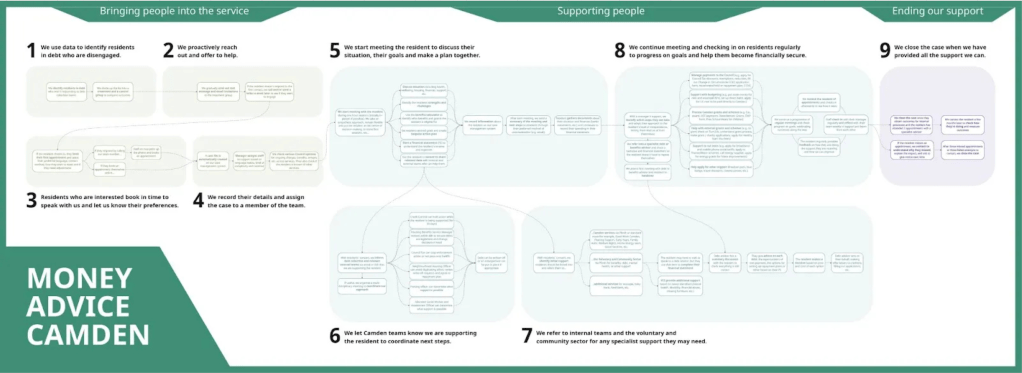
Process map
Financial support
Helping people in debt to the Council get the right financial support early, by making advice easier to access and coordinating the help across teams.
Design maturity of the local authority team (service delivery team and other internal stakeholders)
Embedding: The team uses a service design approach for many of its change activities, and the impact on resident experience and outcomes is starting to be seen. Team roles, ways of working, and resources are starting to shift to support this approach.
Author’s role
As the senior service designer, I led the whole project — from scoping to implementation — shaping the approach, planning each step, and supporting colleagues across the service to co-design something new. I created the tools and prompts that helped us move from abstract ideas to a clear service model, including the journey map that guided key decisions. I also supported the team by setting up the right digital systems, writing guidance, and making sure everything we tested was practical and grounded in real delivery.
What was the purpose of the method you used? How did it support your work?
Visualise and bring ideas to life
Turned everyone’s insights into a clear, shared visual story, making the service concept tangible and easier to socialise, test, and iterate.
Build a shared vision
Helped clarify and align the team’s understanding of the full resident experience.
Engage service staff
Created space for frontline workers and managers to regularly contribute, becoming active collaborators and leaders.
Identify gaps and opportunities
Highlighted where support was missing or could be improved, guiding design decisions.
Inform system and resource needs
Made it easier to pinpoint digital tools, guidance, and collaboration required at each stage.
Key enablers
- Leadership support: A senior director and an innovation-led head of service created space and backing for design-led work
- Open and curious staff: People brought insight, experience and honesty
- Time-boxed, regular sessions: Short weekly workshops made participation manageable
Key challenges
- Tense relationships with the voluntary sector: We couldn’t involve them directly at this stage
- Mixed internal buy-in: Some teams were stretched or had low trust based on past experiences
- The map was only one step: It helped us design, but the hard work came after in implementation
Key enablers
Leadership support
A senior director and an innovation-led head of service created space and backing for design-led work
Open and curious staff
People brought insight, experience and honesty
Time-boxed, regular sessions
Short weekly workshops made participation manageable
Key challenges
Tense relationships with the voluntary sector:
We couldn’t involve them directly at this stage
Mixed internal buy-in
Some teams were stretched or had low trust based on past experiences
The map was only one step
It helped us design, but the hard work came after in implementation
What?
Camden set out to design a more joined-up, compassionate approach to debt and money-related support. Residents were facing fragmented services, often hitting crisis point before receiving help. The aim was to create and test a new approach to financial support that works across internal teams and external partners to help residents achieve long-term stability. This means building trust, understanding each person’s situation, offering tailored help, and connecting them to other services when needed. As part of this wider service design process, I used a journey map to bring ideas together, clarify the flow of support, and support practical decisions about how the service would work.
Why?
Previous approaches focused heavily on recovery and enforcement, with little room for proactive or preventative support. Teams were working in silos and residents often had to navigate complex systems on their own. The new service needed to feel human, coordinated, and accessible — especially for those in vulnerable financial situations.
How?
I set up weekly sessions with a small group of frontline staff and managers to explore key design questions. These included what kind of support the service should offer, how people would access it, and how we’d work with other teams. I built an early version of a process map in Miro to visualise our ideas and prompt conversation. It evolved week by week based on what came up in the sessions and in one-to-one conversations with staff from benefits, council tax and debt recovery. The final map helped the team describe what we were trying to build and why. It supported buy-in, scoping and alignment.
Who?
As senior service designer, I led the project—planning, supporting colleagues, creating tools, and setting up digital systems. A researcher led initial research, data sharing, and outcome measurement. The core group included the new Head of Service, managers, and frontline staff, all helping shape the service and sharing expertise. We had support from a senior director who championed the work. And we also collaborated with other internal teams who contributed valuable debt and benefits expertise and helped build joined-up working despite heavy workloads.
When?
I created the journey map during the design phase for what became Money Advice Camden. Sessions happened weekly, with edits and follow-up conversations in between. This work took place across early and mid 2024.
So what?
The journey map turned abstract ideas into a clear, practical format that people could feedback on. It helped people see their role in the process, identify risks, and understand how their team contributes. This shared understanding supported key design decisions and laid the foundation for a service that’s now helping more residents achieve financial stability and access the right support when they need it. For example, in April this year, Camden proactively reached out to residents with council tax final notices. From the first 100 text messages sent, 24 residents requested support, leading officers to identify around £8,000 in unclaimed Council Tax Support and exemptions—reducing debts and preventing further escalation.
What would you differently next time?
The map served its purpose during design, helping turn abstract ideas into something tangible the team could build on. But once the service took shape, it faded out of use. Next time, I’d make a version that’s easier for the team to update themselves — or print it out to keep it visible. That might help it stay useful for longer.
Details of the design method
At this stage of the project, we had prioritised one idea to develop: creating a centralised Camden team that would proactively reach out to residents in debt and offer tailored financial support. To bring this idea to life, we needed to define it clearly, co-design it with service colleagues, and make it testable. Process mapping became a key tool to guide this work.
Before creating any maps, I focused on setting strong foundations. I wrote up a clear set of objectives for the new service and pulled together examples from other councils and organisations doing similar work — including the Liberated approach in Gateshead, Hackney’s Money Hub and Link Worker models, and Southwark’s Step-by-Step programme. I shared these with the service team — a group of managers and frontline staff — highlighting what we could learn from each and what might work in Camden.
To shape the model together, I prepared a series of design questions to explore with the team each week. These covered practical decisions like: What type of support are we offering? How will we approach people? What proof do we ask for? How do we work with other teams? I added example answers to prompt discussion, and we met for an hour each week to build a shared view of what we were testing.
Once we had the rough outlines, I created a first draft of the journey map in Miro, using prompts and placeholders to reflect what we’d discussed and surface the gaps. We reviewed it as a group and used it to keep making decisions and refining the model. I then updated the map and began testing it more widely.
To do this, I booked one-to-one chats with colleagues in debt and benefits teams across the Council — walking them through the map, explaining the proposed service, and collecting feedback directly in Miro using post-its. Their input helped strengthen the model and surface areas we needed to tweak or clarify.
The result was a more complete journey map that reflected different perspectives. It became a tool to socialise the new service with wider stakeholders, explain how it would work day to day, and build buy-in. We also used it to identify the digital and system requirements at each stage of the process, as well as the guidance and tools staff would need to deliver the service.
The map continued to evolve as we tested the service, but its main value was in helping us get from idea to action — shaping the model collaboratively, building confidence, and setting the direction for delivery.


 LGSDN
LGSDN 