
Overview
Design Practice
Process Mapping
Service Area
Financial Support
Service Challenge
Transitioning from reactive, transactional services to preventative, relational service delivery
Project Summary
Camden Council set out to create and test a new, more joined-up and compassionate approach to financial support, shifting from a system focused primarily on recovery and enforcement toward one that enables earlier, proactive and preventative support. The ambition was to make financial advice easier to access, coordinate help across teams, and support residents in achieving longer-term financial stability before problems escalated.
Residents experiencing debt often encountered fragmented services and complex pathways, frequently reaching crisis point before receiving help. Teams were working across separate processes and systems, making it difficult to identify residents who might benefit from early intervention or to provide coordinated support. Designing a new approach required both a shared vision and a practical model that teams could test and refine together.
As part of designing what became Money Advice Camden, I led the development of a process/journey map to help the organisation move from high-level ambition to a clear, testable service model. The work took place across early and mid-2024 and involved a core working group of frontline staff and managers across benefits, council tax, and debt recovery, supported by a researcher leading insight gathering and outcome measurement. The work was championed by a senior director and supported by an innovation-focused Head of Service, creating the space needed for cross-team collaboration and experimentation.
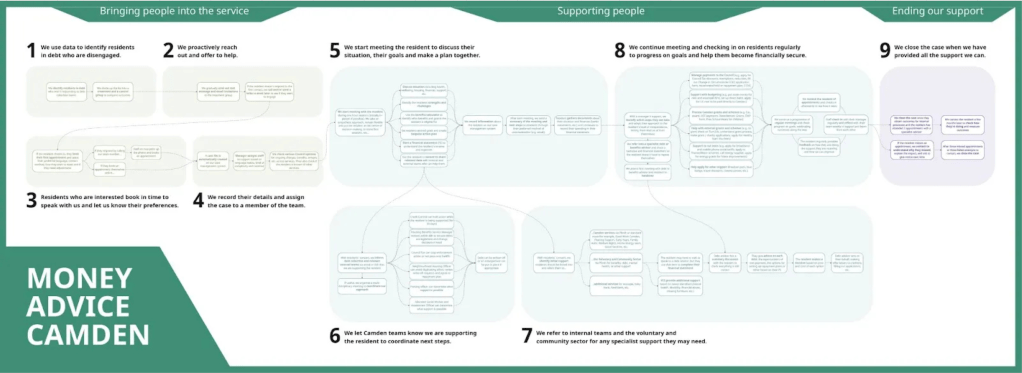
Through weekly co-design sessions and follow-up conversations with colleagues across services, the map evolved into a shared visual representation of how the new proactive support model would work in practice — including how residents would be identified and contacted, what support would be offered, how teams would collaborate, and what systems and tools would be required. The mapping process helped teams align around a common direction while identifying risks, gaps, and implementation requirements early.
Early testing of the new approach demonstrated encouraging results. For example, when Camden proactively contacted residents who had received council tax final notices, 24 of the first 100 residents contacted requested support, enabling officers to identify approximately £8,000 in previously unclaimed Council Tax Support and exemptions. This helped reduce debts and prevent further escalation, illustrating the potential of earlier, more coordinated intervention.
Method
Process mapping was used as a core co-design and service modelling tool to support both the creation and early testing of the new service approach.
I began by clarifying the objectives for the new proactive financial support model and gathering examples from other councils and organisations to prompt discussion and learning. A small working group of managers and frontline staff then met in weekly one-hour sessions to explore key design questions, including what support the service should provide, how residents would be contacted, what evidence might be required, and how the service would work across teams.
Using these discussions, I created an initial process map in Miro, intentionally leaving placeholders and open questions to highlight areas requiring decisions. The map was reviewed and refined each week, supported by additional one-to-one conversations with colleagues across benefits, council tax, and debt recovery. Feedback was captured directly on the map using digital post-its, allowing the service model to evolve collaboratively and transparently.
As the model developed, the map was also used to identify system, data, and resource requirements at each stage of the process, helping teams understand what would be needed to move from concept to implementation. The artefact became an important tool for communicating the emerging service to wider stakeholders, supporting buy-in and aligning delivery teams around a shared understanding of how the new approach would work.
How this design practice supported the work?
Process mapping played a critical role in helping the organisation turn an ambition for proactive, compassionate financial support into a practical, testable service model. It enabled teams to see how their roles connected across the full resident journey, supported collaborative decision-making, and highlighted gaps or risks that needed to be addressed before implementation. Process mapping helped operationalise proactive financial support. Visualising how residents would be identified, contacted, and supported enabled the team to translate a strategic ambition into a testable delivery approach.
By making the service visible and discussable, the mapping process strengthened cross-team ownership and helped create the operational clarity needed to begin testing the new approach.
Reflections
- Senior leadership sponsorship created the organisational space to design and test a more proactive, compassionate approach to debt support.
- Frontline expertise shaped a realistic service model. Managers and frontline staff from benefits, council tax, and debt recovery brought operational insight that ensured the proposed proactive outreach model could work in practice.
- Collaborative process mapping strengthened cross-service coordination. Building the process map together helped teams understand how proactive outreach, tailored advice, and referrals would connect across services, creating shared ownership of the new model.
- Weekly one-hour co-design sessions maintained steady progress. A consistent but manageable engagement rhythm allowed busy operational teams to participate while continuing day-to-day delivery work.
- One-to-one conversations uncovered operational detail that workshops missed. Walking colleagues through the map individually surfaced practical considerations around evidence requirements, handoffs, and system constraints.
- Capacity pressures affected engagement in some teams. Heavy workloads and past experiences of change initiatives meant some areas were slower to engage, requiring ongoing relationship-building and reassurance.
- Limited involvement of voluntary sector partners constrained early ecosystem design. At this stage, strained relationships meant external advice providers could not yet be fully involved, limiting opportunities to co-design the wider support pathway.
- Collaborative mapping improved understanding of interdependencies between services. Seeing the full end-to-end journey clarified how decisions in council tax, benefits, and debt recovery affected residents’ experiences and outcomes.
- Design artefacts need a sustainability plan. Although the process map was highly valuable during design and testing, it became less used once implementation progressed; creating a simplified, team-owned version earlier could have extended its operational usefulness.
- Using mapping as a shared working space built trust across teams. The evolving Miro map created a transparent environment where teams could contribute ideas, challenge assumptions, and gradually align around a new proactive service model.
Author
Elsa Bardout
London Borough of Camden

 LGSDN
LGSDN 