
Overview
Design Practice
Journey Mapping
Service Area
Adult Social Care
Service Challenge
Managing rising ASC demand through improved triage and automation
Project Summary
Kingston Council, funded by the Department for Levelling Up, Housing and Communities (DLUHC), led a cross-council discovery with six partner authorities — West Berkshire, Greenwich, Dorset, Southwark, Redbridge, and Merton — to explore how adult social care triage could be supported through automation. Adult social care teams are experiencing rising demand, leaving social workers under increasing pressure to manage complex referrals with limited time and administrative support.
The project aimed to understand how complex referral information could be structured more effectively to make triage and assessment processes faster, clearer, and more consistent, while still valuing professional judgement. Through research across seven councils, the team identified shared challenges around fragmented processes, inconsistent data capture, and duplicated manual work. One outcome of the discovery was supporting the early design and concept development of Beam (Magic Note), which progressed to Alpha as part of the programme.
Method
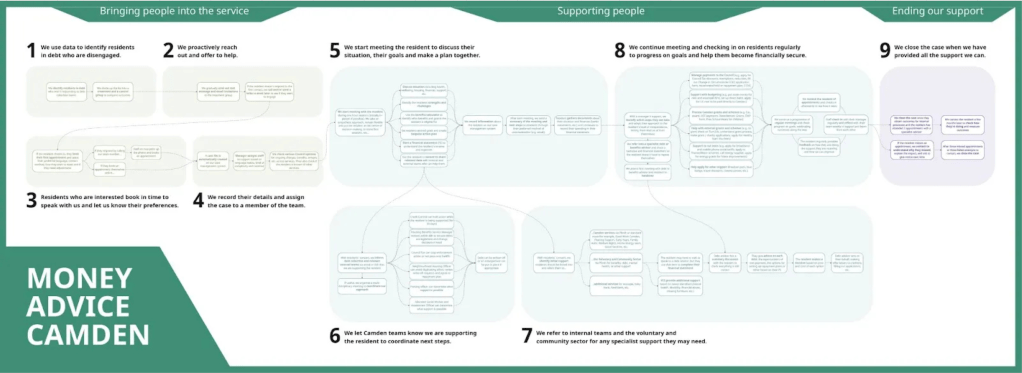
Journey mapping was used throughout the discovery to help make complex cross-council processes visible and comparable. Early journey maps supported the case for funding, and later iterations helped consolidate research insights and guide ideation.
Research began with shadowing social workers in Kingston and conducting interviews with staff across partner councils. Notes, case walkthroughs, and system screenshots were collected to understand real workflows, decision points, and bottlenecks. User needs for different roles were captured in a shared spreadsheet and validated with stakeholders across councils to identify patterns and common issues.
Using these insights, “as-is” journeys were mapped to visualise how social workers currently manage triage and referrals, highlighting pain points such as repeated data entry, information chasing, and inconsistent processes. Draft maps were iterated collaboratively with the multidisciplinary project team, refining stages, systems, and challenges. The journey maps then informed a broader service map and were used as the basis for storyboards that communicated research findings clearly to DLUHC and council leadership, helping secure the next stage of funding.
How this design practice supported the work?
Journey mapping provided a shared visual language that helped seven councils align around common problems despite different local systems and organisational structures. It made hidden administrative work visible, helped identify opportunities for automation and process improvement, and enabled multidisciplinary teams to move from scattered insights to a coherent set of opportunity areas. By translating research findings into clear visual journeys, the team strengthened stakeholder understanding and supported decision-making for the Alpha phase.
Reflections
- Strong cross-council sponsorship enabled collaboration. Funding from DLUHC and a jointly delivered discovery created the organisational mandate for seven councils to work together, making it possible to explore shared Adult Social Care triage challenges rather than addressing them in isolation.
- Multidisciplinary teamwork strengthened insight-to-action translation
- Close collaboration between product, service design, research, architecture, and council stakeholders allowed operational challenges to be understood from multiple perspectives and translated more effectively into opportunity areas for Alpha.
- Journey mapping created a shared language across different systems and processes
- Councils operated with different triage structures, tools, and recording practices. Visual journey maps helped teams compare experiences, identify common bottlenecks, and align around a collective understanding of the problem space.
- Time-limited discovery constrained depth of engagement
- Working across seven councils within a short timeframe required prioritising which teams and stakeholders to engage, limiting opportunities for deeper exploration in some areas.
- Process variation increased complexity of synthesis
- Differences in workflows, team structures, and systems made it more challenging to produce comparable journey views, requiring additional effort to identify patterns that held across authorities.
- Journey mapping functioned as both a research and strategic alignment tool
- Beyond synthesising insights, the maps helped communicate findings clearly to leadership and funders, supporting decision-making and momentum toward the next programme phase.
Author
Zoey Zheng
Royal Borough of Kingston upon Thames

 LGSDN
LGSDN 