Design Practice: Storyboarding
Service Area: Enforcement
Service Challenge: Organisational transformation
Storyboard:
Storyboard is a visual design practice that represents how a service might operate through sequences of scenes. It helps stakeholders interpret abstract models more concretely, explore operational implications, and engage with how services function in practice across time, roles, and environments.
Project Summary
I worked on an enforcement review at the London Borough of Hounslow, looking at how a fragmented set of enforcement activities could be brought into a more coherent model. Enforcement in the borough spans responses to multiple issues such as fly-tipping, antisocial behaviour, noise complaints, parking offences, etc and was distributed across at least seven or eight teams, as well as external contracts.
This work was not happening in isolation. It followed a programme that sought to improve operations in Safer Communities service areas, which had already left teams adjusting to new roles and boundaries. At the same time, the council was implementing a major digital transformation aiming to create a single front door for residents. As a result, I was working within a system that was actively changing while I was trying to understand and redesign it. This method was used during the development phase, where I was trying to build a shared understanding of the high-level operations of a new service to inform further development..
Method
This method was used in the later design and early implementation phase, when a target operating model existed but needed to be made more tangible.
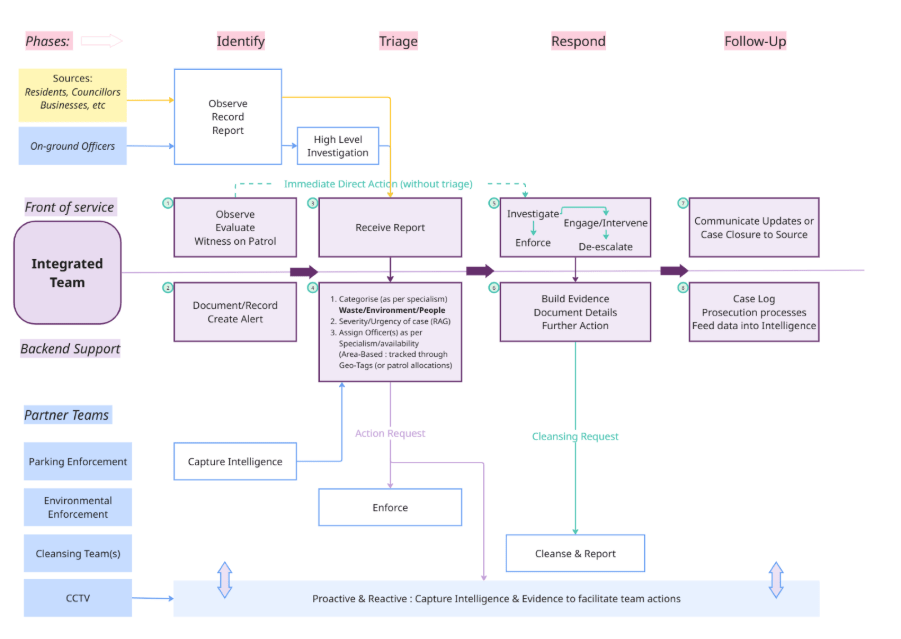
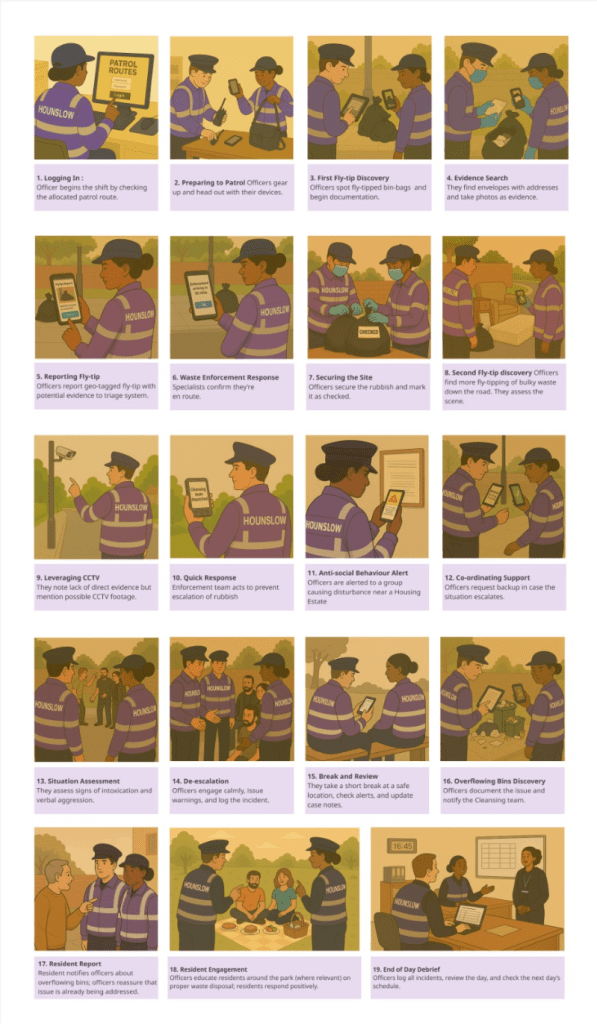
I used an AI-generated storyboard to translate the target operating model into something more tangible. The model itself explained process flows through triaging and response, but it did not help stakeholders imagine how the service would actually operate.
I broke the model down into scenes and created visual representations of those moments. The intention was to move from abstraction to something closer to lived experience.
The storyboard prompted a different kind of engagement. Stakeholders responded to details within the scenes, which led to practical discussions about operations. One example was a small detail that triggered a conversation about working hours and overtime.
I found that this method works best when it focuses on activity and context, not just visual appeal. It needs to show how the service functions in practice, not just what it looks like.
It was particularly useful in this project because implementation conditions were not fully stable. The storyboard helped maintain a shared understanding of the intended service, even as delivery constraints became more apparent.
How this design practice supported the work?
This practice supported the work by making the future service more interpretable and discussable. It helped stakeholders move from understanding the structure of the service to considering its operational implications.
It also helped sustain momentum in a context where full implementation was not yet possible.
The storyboard supported the work by making the future service easier to interpret and discuss. It enabled stakeholders to move from abstract understanding to practical questioning.
Reflections
- Visualisation shifted the level of conversation: Stakeholders moved from abstract discussion to practical questioning once they could see the service in context.
- The method exposed operational realities that had been overlooked: Small details in the storyboard triggered important discussions about how the service would actually function.
- It worked well in an unstable delivery context: The storyboard helped create alignment even when infrastructure and organisational conditions were still evolving.
- Design work extended beyond traditional boundaries: This method connected closely with communication and launch activity, showing how service design often overlaps with change and implementation work.
- The final service did not fully match the intended design: It is important to acknowledge that what launched was a partial version of the intended service. The method supported understanding, but could not resolve structural constraints.
- The project had reached a facilitation ceiling: More discussion was not producing more clarity. The method worked because it changed the nature of the interaction.
- Critique revealed more than ideation had: Stakeholders were able to articulate their reasoning more clearly when reacting to something than when asked to generate ideas from scratch.
- The organisational context shaped the effectiveness of the method: In a risk-averse setting, critique felt safer than proposal. The method aligned with that behaviour rather than trying to change it.
- Provocation is powerful but needs careful handling: Without clear framing, it can create confusion or defensiveness.

I am Namita Manohar, Service Designer at the London Borough of Hounslow.
 LOCAL GOVERNMENT SERVICE DESIGN NETWORK