Overview
Design Practice: Provocation
Service Area: Enforcement
Service Challenge: Organisational transformation
Provocation or The Reddit trick: using wrong answers to unlock better decisions
Provocation through deliberately wrong models is a facilitation practice that uses flawed or imperfect representations to prompt critique. By reacting to what does not work, stakeholders surface assumptions, constraints, and priorities, helping move design conversations forward when ideation or discussion has stalled.
The approach was inspired by a well-known Reddit pattern: instead of only asking a question, you post the wrong answer and people quickly jump in to correct you. I applied this logic to the design process. I created deliberately flawed operating models based on ideas already discussed and presented them to stakeholders. Rather than asking “what should we do?”, I asked “why doesn’t this work?”
Project Summary
I worked on an enforcement review at the London Borough of Hounslow, looking at how a fragmented set of enforcement activities could be brought into a more coherent model. Enforcement in the borough spans response to multiple issues such as fly–tipping, antisocial behaviour, noise complaints, parking offences etc, the responsibility of which was distributed across at least seven or eight teams, as well as contracted service providers.
This work was not happening in isolation. It followed a programme that sought to improve operations in Safer Communities service areas, which had already left teams adjusting to new roles and boundaries. At the same time, the council was implementing a major digital transformation aiming to create a single front door for residents. As a result, I was working within a system that was actively changing while I was trying to understand and redesign it.
Method
I used provocation when I realised that conventional facilitation was no longer moving the work forward. We had working groups, structured discussions, and engagement with stakeholders, but the operating model was not materialising.
I created deliberately wrong models based on ideas that had already surfaced in conversations. I then introduced specific flaws into those models to expose tensions and trade-offs. These were not random provocations. They were grounded in the project’s reality.
The key part of the method was asking why the models did not work. This shifted the conversation from opinion to reasoning. Stakeholders began to articulate constraints, dependencies, and requirements that had previously remained implicit.
This approach worked particularly well in a complex environment with layered challenges to co-design. It allowed people to engage through critique rather than requiring them to propose solutions themselves. However, it also required careful framing to avoid confusion about whether the models were serious proposals.
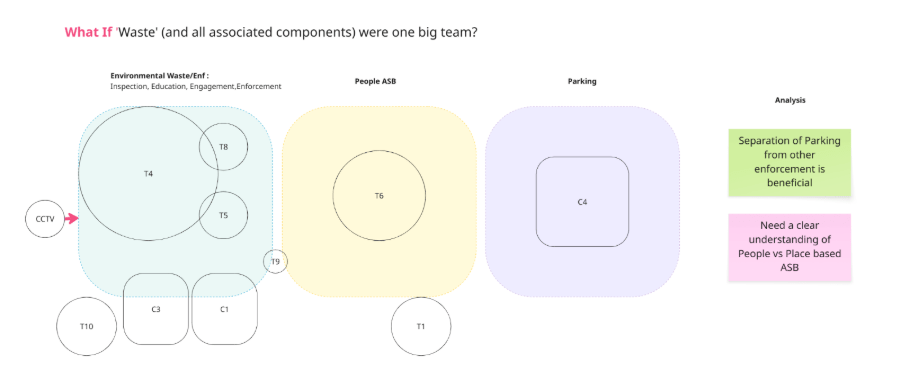
How this design practice supported the work?
This practice helped unlock decision-making by making abstract discussions more concrete. It gave stakeholders something to react to, which made it easier for them to express what mattered and what would not work in practice.
It also surfaced hidden assumptions and criteria that had not been articulated previously.
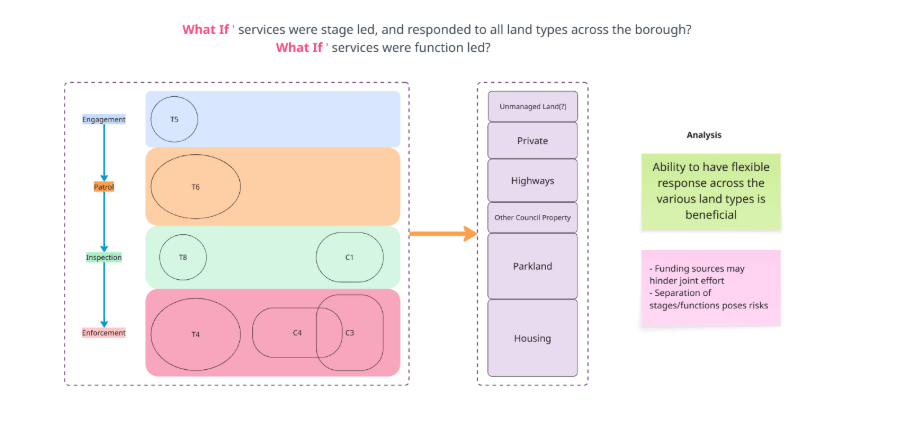
Reflections
- The project had reached a facilitation ceiling: More discussion was not producing more clarity. The method worked because it changed the nature of the interaction.
- Critique revealed more than ideation had: Stakeholders were able to articulate their reasoning more clearly when reacting to something than when asked to generate ideas from scratch.
- The organisational context shaped the effectiveness of the method: In a risk-averse setting, critique felt safer than proposal. The method aligned with that behaviour rather than trying to change it.
- Provocation is powerful but needs careful handling: Without clear framing, it can create confusion or defensiveness.
I am Namita Manohar, Service Designer at the London Borough of Hounslow.
 LOCAL GOVERNMENT SERVICE DESIGN NETWORK